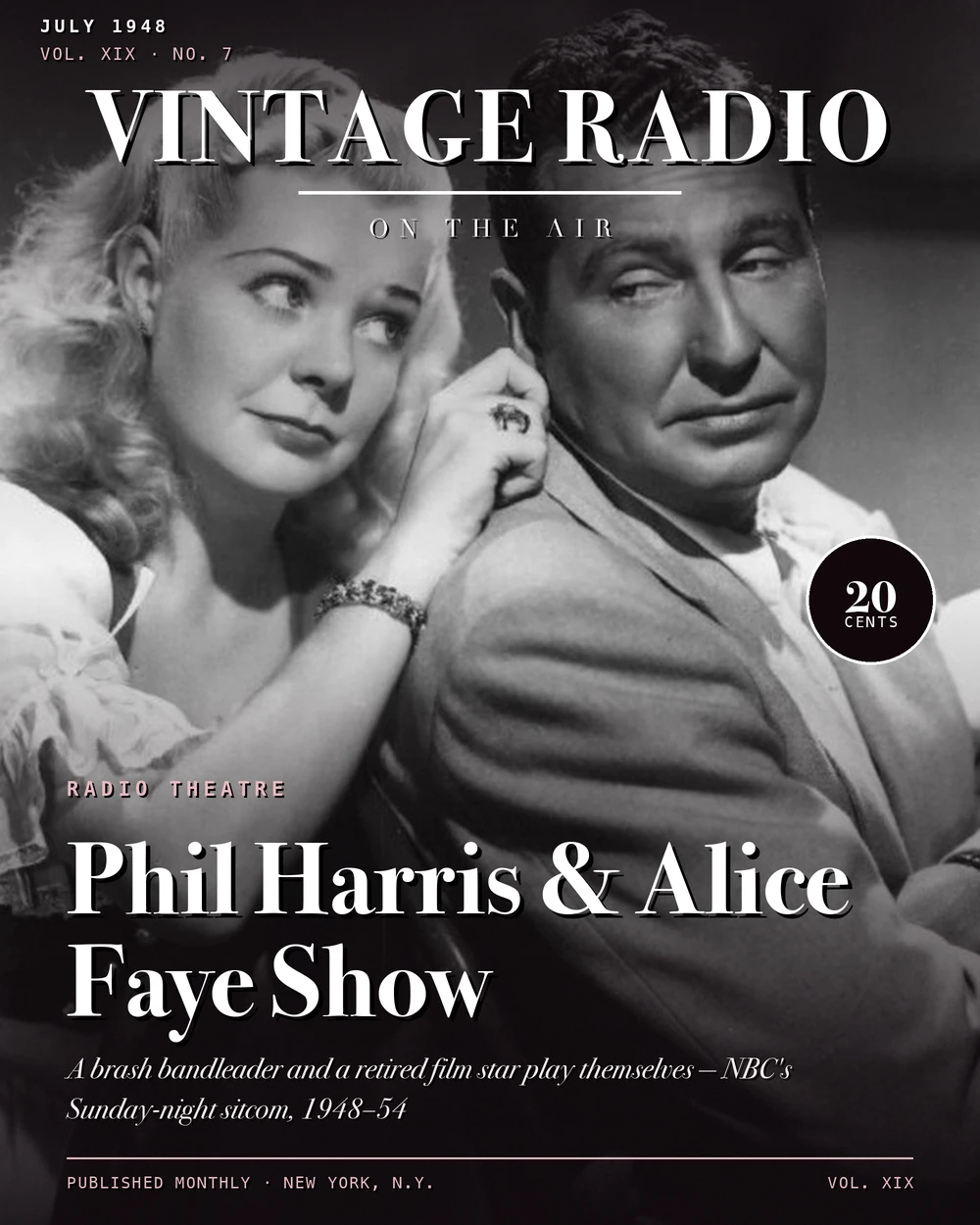
Phil Harris & Alice Faye Show
Where It Came From
Phil Harris had spent ten years on The Jack Benny Program before he and Alice Faye launched their own show, and the new program grew directly out of what he'd built there. Since 1936, Harris had been playing a version of himself on the Benny show — loud, vain, hard-drinking, and casually contemptuous of everyone around him. By the mid-1940s that character was polished to a high shine, and the logical next step was to give it a house to live in.
The show premiered on September 29, 1946 on NBC, initially under the title The Fitch Bandwagon, sponsored by Fitch Shampoo. It aired Sundays at 7:30 and, in its early weeks, followed immediately after the Benny program — Benny's show would sometimes end with Harris calling out "So long, Jackson," and the scene shifted directly to the new program. The format centered on Phil's home life with Alice Faye, their two daughters, and the various wiseguys who drifted through the Harris orbit.
The first season's scripts came largely from Joe Connolly and Bob Mosher, who later created Leave It to Beaver for television. By the 1946–1950 stretch, the head writers were Ray Singer and Dick Chevillat, whose scripts were, by common account, so densely packed with jokes that four-to-five-minute cuts were routinely necessary just to allow for audience laughter. The audience microphones were placed overhead to maximize the effect of that laughter, making the show one of the loudest on the air. Singer later told radio historian Gerald Nachman that he and Chevillat considered the Harris-Faye assignment a "writer's paradise" — Harris left them entirely alone and never asked to see scripts in advance.
The Characters and the Cast
Harris played himself: a zany, egotistical bandleader of questionable musical ability who mangled any word of more than two syllables and was impressed primarily by his own curly hair and wardrobe. Faye played herself too — a glamorous former film star who had walked away from Hollywood to be a wife and mother, and who delivered ballads and tart one-liners in equal measure. Their comic timing together was natural enough that the domestic setup never felt forced.
The supporting cast filled out the chaos. Elliott Lewis played Frankie Remley, the hard-drinking, sardonic guitar player in Phil's band, and the character became something close to a comic masterpiece. The real Frank Remley had known Harris since the mid-1920s and worked in the Benny band, but when the time came to give the character a speaking role, the real Remley auditioned and wasn't considered good enough. He recommended Lewis instead. Lewis played Remley with such deadpan flatness that his opening line each episode — "Hiya, Curley" — drew audience laughter before any joke had actually been told. His standard weekly device was the setup line "I know a guy," which sent Harris off to some cut-rate expert who would reliably make whatever problem he had considerably worse.
Walter Tetley played Julius Abbruzio, the insufferable grocery delivery boy with a high-pitched Brooklyn accent, whose creator had also played a child character on The Great Gildersleeve. What made the casting quietly remarkable was that Tetley was an adult man — a rare medical condition had prevented puberty, leaving him with the voice and appearance of a preteen boy for his entire career. Harris reportedly referred to Tetley in pre-air warmup sessions as "the kid who steals the show every week," even when Tetley was approaching forty. Julius arrived in the second half of each program, reliable as weather.
Rounding out the household was Alice's brother Willie, played by Robert North (and later John Hubbard from around 1953), a deadbeat and a heckler who roomed with the family and whose weekly entrance line — "Gooooood morning, Philip!" — was timed for maximum irritation. Gale Gordon played Mr. Scott, the harried Rexall Drug Company representative who was nominally Phil's boss. Jeanine Roose and Anne Whitfield played the Harris daughters, written with their "father's" brash mannerisms and given genuinely funny lines of their own. Supporting players were frequently drawn from Jack Benny Program regulars, including Frank Nelson, Sheldon Leonard, and the Sportsmen Quartet. Walter Scharf led the orchestra; Paul Phillips produced and directed.
The Sponsor Years
When Rexall Drug Company came on as sponsor beginning October 3, 1948 — the same date the show dropped the Fitch Bandwagon title and became the Phil Harris-Alice Faye Show — the writers built the sponsor into the storylines rather than interrupting the broadcast with a mid-show commercial. The debut Rexall episode was built around the fictitious day the couple signed their Rexall deal, and Mr. Scott became a recurring target as the perpetually anxious executive trying to manage Phil's chaos. Remley didn't help: in an early show, he asked flatly, "What's a Rexall?" Harris, for his part, once suggested on air that the company could save money and just bottle and sell his personal charm.
Rexall sponsored through June 4, 1950. RCA came on in February 1951, and Mr. Scott transferred seamlessly from one fictional corporate home to the other — Lois Corbett played his wife, Mrs. Scott. The show's timeslot shifted over the years as well: Sundays at 7:30 through 1951, then Sundays at 8 through 1953, and finally Fridays at 9 in the show's last stretch.
In 1949, Jack Benny moved his show to CBS, which created a logistical puzzle since the NBC and CBS studios were two blocks apart and the shows still aired back-to-back. Harris appeared only in the first half of Benny's CBS broadcast, then left by 4:15 Pacific time, cut through the parking lot between studios, knocked on the NBC back door at 4:17, and warmed up his own audience before the Harris-Faye show went on the air. Harris eventually left the Benny program entirely at the end of the 1951–52 season, replaced by Bob Crosby. Harris and Faye, for their part, stayed with NBC throughout — both had declined the CBS talent-raid offers that lured Benny and Burns and Allen, accepting a lucrative NBC counter-offer instead.
What Made the Comedy Work
The show sat at an unusual intersection: closer in spirit to a domestic sitcom than to the variety format it had grown out of, but edgier than most of its competition. Radio historians comparing it to Ozzie and Harriet usually add that it was sharper and more abrasive — the sardonic humor and nightlife references belonged to a different sensibility. The Harris character was loud, usually insulting, and prone to catastrophic overconfidence. He and Remley got into trouble across episodes that involved babysitting, hanging wallpaper, becoming chimneysweeps, and attempting to invent a new drug to impress the Rexall sponsor. The comic tone was not warm reassurance but controlled disaster.
Each broadcast contained two musical numbers. Harris performed novelty material — "Shadrack," "The Thing," "The Preacher and the Bear" — alongside ballads of the South, with "That's What I Like About the South" described as oft-mentioned but seldom actually sung. Faye took songs from her movie days or current hits like "Buttons and Bows," delivering them in a warm honeyed contralto she'd carried since her film years. The mix of genuine musical performance and self-deflating comedy kept the format from feeling like pure sketch comedy.
The Remley character's name was formally changed at the start of the 1952–53 season, in an episode titled "Hotel Harris," in which the character explained that "Frankie Remley" was just a stage name and asked to be called Elliott Lewis going forward. The change came after lawyers convinced the real Frank Remley to seek payment for use of his name; after litigation, Harris simply renamed the character. Lewis later said the change cost the character something essential: "Elliott Lewis just isn't as funny as Frank Remley."
Phil Harris Before and After
Harris was born Wonga Philip Harris on June 24, 1904, in Linton, Indiana — "Wonga" said to derive from a Cherokee word meaning "messenger of fleet" or "fast messenger" — and grew up in Nashville, Tennessee, where he developed the trace of a Southern accent that became central to his radio persona. His parents were circus performers; his father, a tent bandleader, gave Harris his first job as a drummer in the circus band. He began his professional music career as a drummer in San Francisco in the mid-1920s, playing in the Henry Halstead Big Band Orchestra before forming his own group with Carol Lofner. The Lofner-Harris Orchestra held a long engagement at the St. Francis Hotel in San Francisco in the late 1920s and recorded swing music for Victor, Columbia, Decca, and Vocalion Records.
His short film So This Is Harris!, made for RKO in 1933 and directed by Mark Sandrich, won the Academy Award for Best Short Subject (Comedy) at the 1934 ceremony — produced by the same filmmaking team that subsequently made Flying Down to Rio, which launched the careers of Fred Astaire and Ginger Rogers. His novelty recording "The Thing" reached number one on the U.S. chart in 1950 and sold over one million copies. Leo Walker wrote in The Big Band Almanac that Harris was "without doubt one of the strongest personalities ever to front a dance band," and noted that Harris's reputation as a wisecracking frontman may have overshadowed his genuine skill as a drummer. According to Walker, Harris's secret ambition was to play trombone.
After the radio show ended in June 1954, Harris returned to television guest work — The Dean Martin Show, Hollywood Palace, Kraft Music Hall — and to film, including The High and the Mighty (1954) with John Wayne and Good-Bye, My Lady (1956). His voice work for Disney gave him a second lasting career: Baloo in The Jungle Book (1967), Thomas O'Malley in The Aristocats (1970), and Little John in Robin Hood (1973). He spent time in the 1970s and early 1980s performing in Las Vegas, often on the same bill with bandleader Harry James, and after Bing Crosby's death in 1977 replaced him as commentator for the annual Bing Crosby Pro-Am Golf Tournament at Pebble Beach. Harris died of a heart attack on August 11, 1995, in Rancho Mirage, California, at age 91.
Alice Faye's Side of the Story
Alice Faye was born Alice Jeanne Leppert on May 5, 1915, in Hell's Kitchen, Manhattan, the daughter of a New York City police officer and a factory worker. Her entertainment career began in vaudeville as a chorus girl; she found a spot in George White's Scandals of 1931 on Broadway, where Rudy Vallee was also featured — and where Walter Scharf, who would later become the Harris-Faye show's musical director, had worked with Vallee as well. Vallee hired Faye as a singer on his radio show, and her film career followed. She introduced 23 songs to the Hit Parade during her Fox years, more than Judy Garland (13), Betty Grable (12), or Doris Day (12). She was voted the number-one box-office attraction of 1940, ahead of Bette Davis and Myrna Loy.
Her departure from Fox was not gradual. Her last starring film, Fallen Angel (1945), directed by Otto Preminger, was the breaking point: she discovered that Darryl Zanuck had cut 12 of her scenes to boost newcomer Linda Darnell. She handed her dressing room keys to the studio gate guard, drove home, and vowed not to return. Zanuck subsequently blackballed her for breach of contract. The radio show's recurring closing line — "Alice Faye appears through the courtesy of 20th Century Fox" — was read by radio historians as an ironic jab at that acrimonious split. She returned to Fox only once more, for a supporting role in State Fair (1962). In 1974 she returned to Broadway in a revival of Good News, 43 years after her stage debut. Alice Faye died of stomach cancer on May 9, 1998. She and Harris are interred together at the Forest Lawn Mausoleum in Cathedral City, California.
Their marriage lasted 54 years, until Harris's death. Faye once acknowledged that most of Hollywood had predicted it would last six months. The radio program, she later said, gave her exactly the balance she'd wanted — it required only a read-through and a live broadcast each week, which left time to raise their daughters without surrendering show business entirely. The show ran for 297 episodes in total, and surviving recordings from across the run — including a dozen or so from the RCA era that preserved full audience warmup routines — give a clear enough picture of what made Sunday nights at 7:30 worth tuning in for eight years.